
Digital Capacity Management (DCM) provides European workflows for coordinating, planning, and allocating international railway capacity through harmonised digital processes. Currently, planning and allocation processes are characterized by isolated tools, manual coordination, and varying levels of digital maturity. DCM addresses these gaps by providing central tools, definitions for national interfaces, and a European architecture with Telematics TSI based communication.
Central and National Tools: The Backbone of DCM
DCM is defined as a platform where multiple applications coexist and communicate, including the national systems of the stakeholders. It will connect the systems of IMs and RUs to facilitate the complete capacity management process – from advance planning to the actual train run, including algorithms for better capacity harmonisation and faster reply to requests. This benefits customers who receive better rail products, with more capacity for flexible connections throughout Europe, and with higher reliability and ease of use.
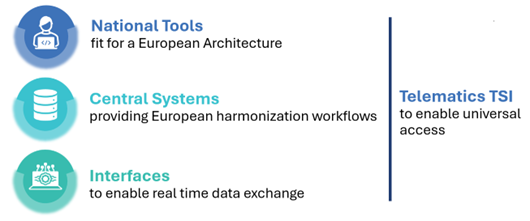
DCM considers two main blocks, the central IT framework and National Tools:
- The central IT framework, developed by RNE, contains two central tools:
- The CPT Tool (Capacity Planning Tool) – to manage workflows for Temporary Capacity Restrictions, Capacity Models, and pre-planned coordinated paths.
- PCS Capacity Broker (Path Coordination System) – a system for requesting capacity and providing offers to Applicants.
- National and external IM and RU systems, which need to communicate with the central IT framework
- National tools remain the backbone of capacity management in each country, and within Digital Capacity Management they serve as the authoritative source of operational and planning data. They are not replaced by the European coordination systems; instead, they are connected by the central DCM tools through standardized interfaces and real-time data exchange via Telematics TSI compliant messages. Thanks to this connection to the national systems, the central DMC tools enable harmonization between Infrastructure Managers, consultation with Applicants, and support transparency across the European network.
Benefits for Infrastructure Managers, Operators, and Regulators
- Infrastructure Managers gain a seamless planning experience, with unified processes for capacity models, TCRs, and allocation.
- Applicants and railway undertakings receive a single booking interface for cross‑border paths—reducing complexity and eliminating the need to navigate multiple national systems.
- All stakeholders benefit from increased transparency and consistent European‑level information flows.
In summary, Digital Capacity Management provides the harmonised European workflows required for efficient, transparent, and coordinated capacity planning and allocation. By linking national systems through central digital tools, DCM enables better use of rail capacity, simplifies the customer experience, and increases the efficiency of processes. It marks a decisive step toward a fully integrated European railway network.
Useful links: PCS knowledge base
Stakeholders Groups in Digital Capacity Management
1. Scope
In order to strengthen cooperation between IMs and Applicants, better take into account user experience, and develop features that more closely meet the needs of applicants, RNE is establishing dedicated Groups.
The DCM Stakeholder Group (DCM SHG), the Capacity Planning Tool User Group (CPT UG) and the Path Coordination System User Group (PCS UG) will provide structured stakeholder input to the respective RNE bodies, i.e. Digital Capacity Management (DCM Technical Board), Capacity Planning Tool (CPT Change Control Board) and Path Coordination System (PCS Change Control Board).
The DCM Stakeholder Group, the Capacity Planning Tool User Group (CPT UG) and the Path Coordination System User Group (PCS UG) act in an advisory capacity and have no decision-making powers.
You find an excerpt of the overview of RNE Capacity Management Groups and Boards and a description of those stakeholders Groups here.
2. Participation in the Groups
The participants in the Groups will comprise:
- the members of the RNE DCM Technical Board, CPT Change Control Board and PCS Change Control Board appointed by the competent RNE bodies;
- participants representing operational stakeholders other than IMs.
Groups members representing operational stakeholders other than IMs, including but not limited to Railway Undertakings and other applicants, shall meet the criteria described here and be nominated by their company via an online nomination form.
The call is continuously open. To take part in the first evaluation round in July 2026, applications must be submitted by 24 July 2026 at 23:59 CET.