
As train operators need to be able to run their trains on the available rail infrastructure, Infrastructure Managers (IMs) provide timetables by means of which train operators’ trains are scheduled. The procedure of requesting, offering and scheduling rail capacity is known as the ‘train path allocation process’.
However, rail infrastructure capacities are scarce in many parts of Europe. Advance planning of available capacities is needed to provide the best and most efficient capacities to operators.
Capacity management processes deal with the long- to short-term planning and allocation of rail infrastructure capacity. This includes the planning of capacities not available due to Temporary Capacity Restrictions (TCRs).
The main goal is to plan capacities efficiently, cross-border, from origin to destination, and provide the market with the maximum available capacity as well as market-oriented high-quality capacity products.
It is RNE’s role to continuously improve and further develop this process. Harmonised procedures and deadlines that are valid for all Infrastructure Managers (IMs) and Allocation Bodies (ABs) within the RNE network benefit the entire rail industry.
IT systems support the processes to raise the quality of information for all stakeholders, accelerate process steps – including the possibility for automatisation – and provide easy access to all stakeholders. RNE’s approach in Digital Capacity Management (DCM) is to make national IT fit to participate in international capacity management processes, provide central IT to handle and combine national IT in all process steps and connect all IT via interfaces.
Governance
Processes and corresponding IT are being developed in collaboration between IMs via RNE with the support of dedicated RNE Joint Office teams. Striving for the best and most accepted solutions, a governance structure of common working formats has been established:
On strategic level, the Capacity Management High Level Group (CM HLG) provides the framework for the activities within Capacity Management. It checks and endorses deliverables created on the operational level and prepares items for approval by RNE, i.e. the Managing Board and the General Assembly. For IT topics, the work of the CM HLG is mirrored in the IT High Level Group (IT HLG).
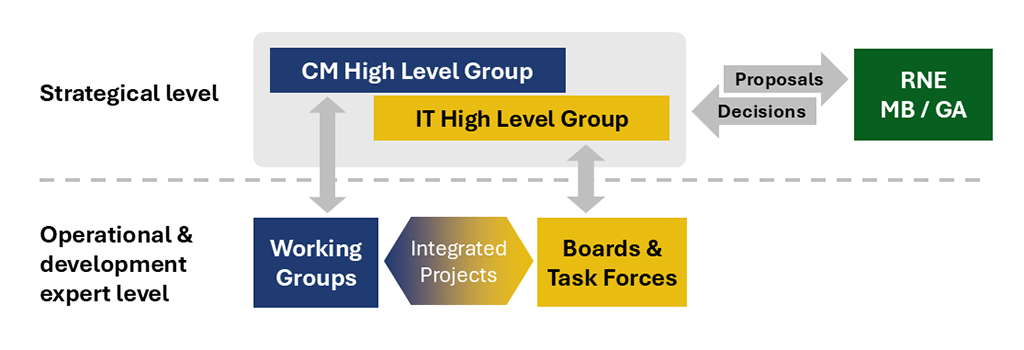
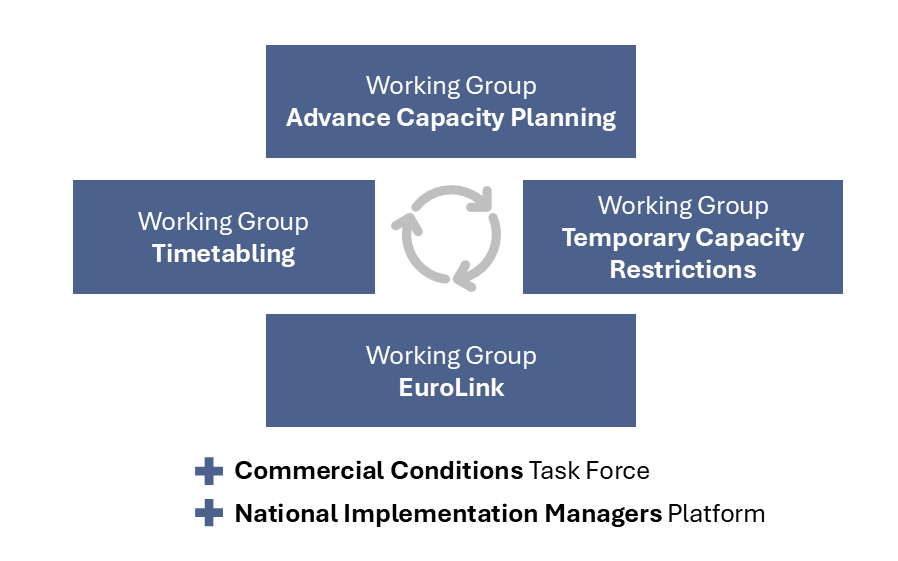
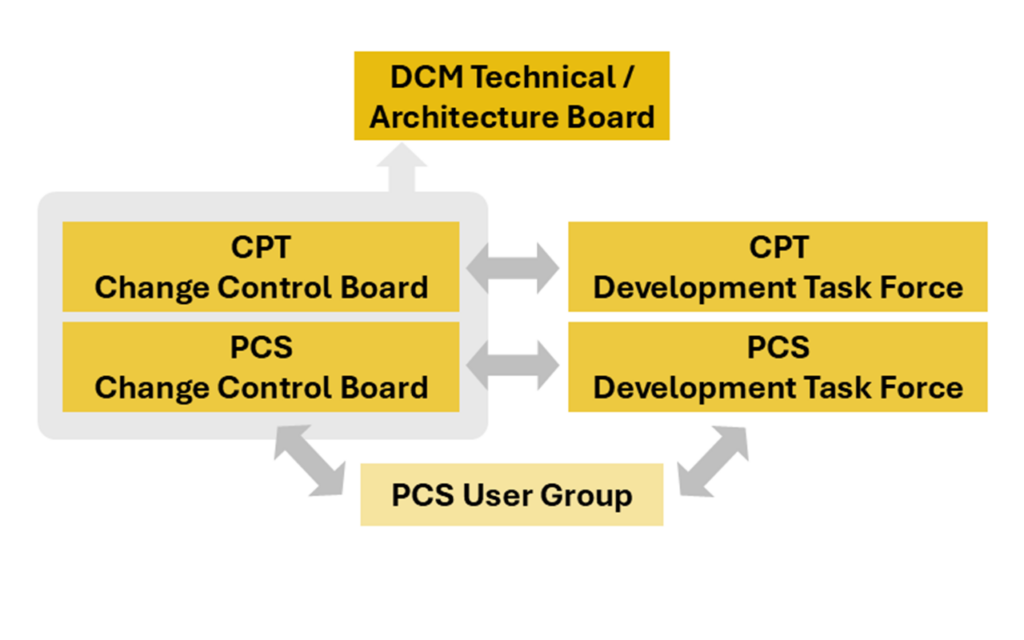
On operational and development level there are four Working Groups designing and finetuning the necessary processes of Capacity Management: Advance Capacity Planning (ACP), Timetabling (TT), Temporary Capacity Restrictions (TCR) and EuroLink. These Working Groups are enhanced by the Task Force working on Commercial Conditions and the National Implementation Managers Exchange Platform (NEP). Change Control Boards (CCB) for Path Coordination System (PCS) and Capacity Planning Tool (CPT) steer the ongoing developments and improvements of the central Digital Capacity Management tools, supported by a DCM Technical Board, development task forces and a PCS User Group.
The close link between process and DCM developments is ensured via integrated projects and interfaces.
Legal Aspects and European Framework for Capacity Management
In July 2023, the European Commission published a draft Regulation determining European rules for Capacity Management (“Capacity Regulation”). This proposal included – among other elements – large parts of the components developed under the Timetable and Capacity Redesign Programme (TTR) programme, which redefined components for a European Capacity Management. The Regulation is expected to enter into force in the second quarter of 2026, legally backing the implementation of European Capacity Management processes and respective IT.
Part of the requirements of the Capacity Regulation towards Capacity Management is the provision of a rulebook in the form of European Framework for Capacity Management (EFCM). The EFCM is to be developed within 18 months of coming into force of the Capacity Regulation and describe all elements of Capacity Management as described in the Capacity Regulation for IMs to follow. RNE has started the drafting process and is expected to provide a first version for consultation with operational stakeholders in the last quarter of 2026. Part of this activity was the identification of elements not yet defined at RNE and provision of respective process outlines throughout 2025 (“Gap Closing”).
Implementation and Funding
In addition to the EFCM, RNE will provide implementation guidelines for IMs. RNE already agreed on Process Handbooks for most Capacity Management processes, which serve as baseline for the EFCM and as means to start the implementation of these processes in a harmonized harmonised way. They will be further enhanced and improved to guide all IMs and Applicants into the full implementation of the Capacity Regulation.
An additional means of converting the Capacity Regulation from paper to reality, the European Union co-funds RNE and its mMembers in view of central and national IT developments. The co-funding is channelled via several Transport Calls and Technical Assistance Calls under the Connecting Europe Facility (CEF) umbrella, steered by the European Climate, Infrastructure and Environment Executive Agency CINEA.